Battle Hanafuda
Details
- Release date: 2026
- Genre: Casual, Strategy, Arcade
- Developer: SUZUKI PLAN, Yoji Suzuki
- Publisher: SUZUKI PLAN, Yoji Suzuki
- Metacritic: tbd tbd
Current prices

|
Unavailable
|
Description
Experience Koi-Koi , the most popular rule set of the traditional Japanese card game Hanafuda, reimagined as a fast-paced, strategic two-player battle.
Even if you’ve never played Hanafuda before , this game is designed to guide you naturally through your first match.
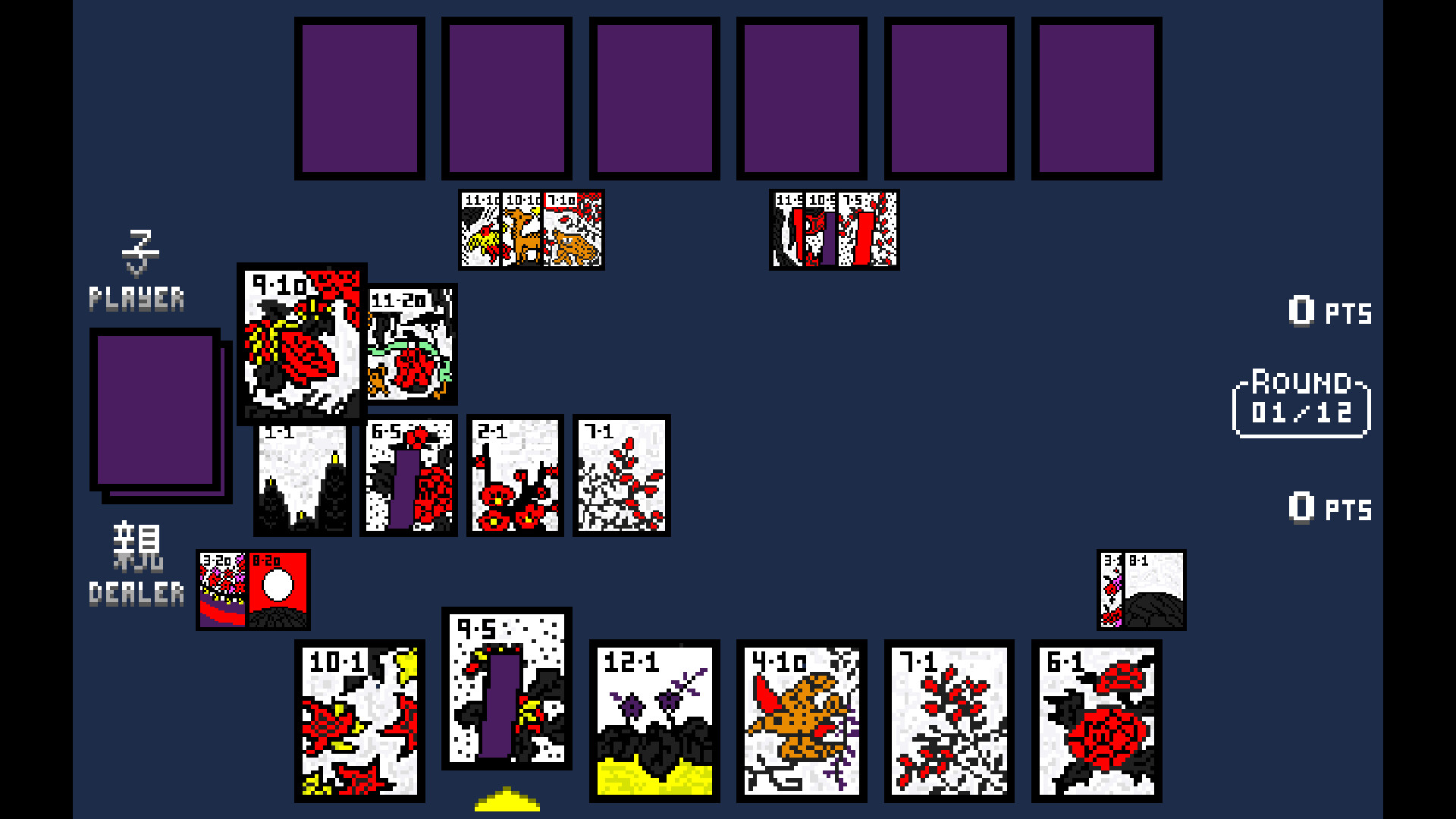
Highlighted card options, automatic capture suggestions, and intuitive visual cues ensure you always understand what you can do—and how close you are to completing a powerful yaku (scoring hand).
With a single button, you can check the full list of hands at any time.
Enjoy the depth of Hanafuda with the smoothest, most accessible experience possible.
🧩 Differences Between the Full Game and the Demo
The full version of Battle Hanafuda is planned to include the following features in addition to the content available in the demo:
Online multiplayer (Friend Matches and Random Matchmaking)
Steam online feature support (Achievements / Leaderboards / Cloud Saves)
A story mode with a proper ending to play toward
Please note that online multiplayer will be unlocked for free in the demo only during the first Steam Next Fest of 2026.
If you’d like to try it during the festival, be sure to add the game to your Wishlist so you don’t miss the opportunity.
🛜 Online Multiplayer
From the title screen, place the cursor on “Free Play (vs CPU)” and press the left or right button to switch to “Free Play (Online)”.
Quick Match
Match with a random opponent online.Friends Match
Match online with players on your Steam Friends list.Create Private Room
Create a private room using a custom ID and invite other players to join.
(Share the room ID via chat or other means.)Join Private Room
Join an existing room by entering its ID.Log
View the results of your last 12 online matches and check your opponents’ Steam profiles.
A Private Room ID is created by choosing any 6-character code.
During online matches, to maintain a fast-paced experience, the pause function and hand list are disabled, and all inputs are subject to a time limit.
🌸 Features
Faithfully follows the official “Koi-Koi” rules used in tournaments and by Nintendo
All cards show their month (1–12) and point value (20 / 10 / 5 / 1) in Arabic numerals
Designed so even beginners can quickly understand the gameplay
Strategic and thrilling matches with risk-reward “Koi-Koi” doubling mechanics
🎴 What is Hanafuda?
Hanafuda (花札) is a traditional Japanese playing card game derived from naipes, a type of card introduced from Portugal in the 1540s.
The deck consists of 12 suits representing the months from January to December, for a total of 48 cards.
Each month has four cards, divided into the following four categories:
Bright (Hikari-fuda) — 20 points, 5 cards in total. The highest-scoring cards.
Animal (Tane-fuda) — 10 points, 9 cards showing animals or objects.
Ribbon (Tanzaku-fuda) — 5 points, 10 cards featuring poetic ribbons.
Chaff (Kasu-fuda) — 1 point, 24 cards showing small background motifs.
Among the Ribbon cards:
Those from January, February, and March are called Red Ribbons (Aka-tan) — red ribbons with writing.
Those from June, September, and October are called Blue Ribbons (Ao-tan) — blue ribbons without text.
Hanafuda is also known as Hana-karuta or Hana-koppai (literally “flower cards”).
Interestingly, Nintendo , originally founded in 1889 as Nintendo Koppai, began as a Hanafuda card manufacturer —
a fascinating piece of history showing how deeply these traditional cards are woven into Japanese culture.
🎴 What is Koi-Koi?
Koi-Koi is a two-player duel that blends elements of poker and mahjong.
The game begins with 8 face-up table cards, 8 cards dealt to each player,
and a remaining deck of 24 cards.
Players (dealer and opponent) take turns playing one card from their hand.
If it matches the same month as a card on the table, both cards are captured.
If not, the played card is discarded onto the table.
Then, the player flips the top card of the deck and captures or discards it in the same way.
These steps are repeated alternately until both players run out of cards.
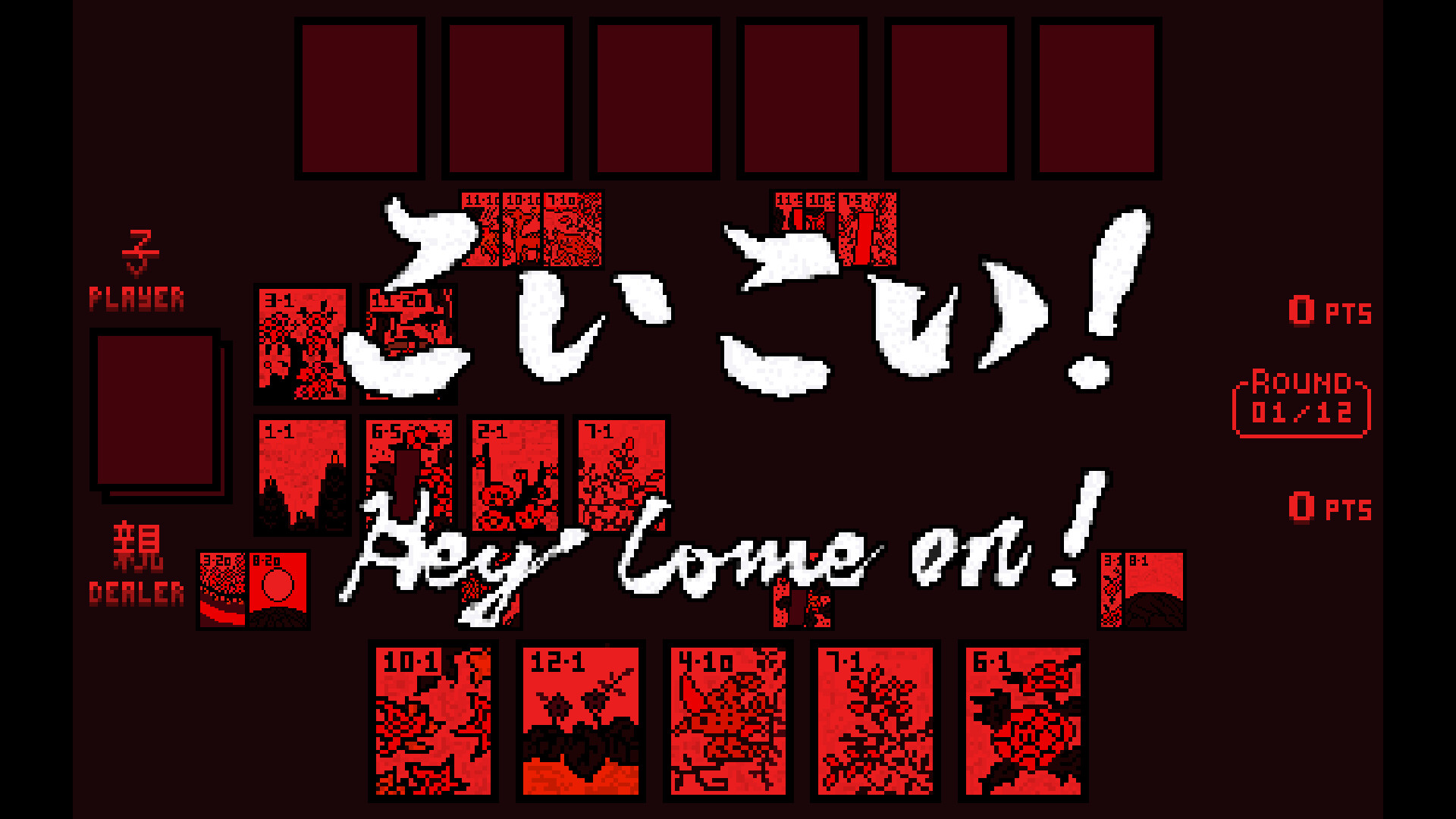
When a scoring hand is completed with captured cards, the player may choose either to “Finish” (end the round) or declare “Koi-Koi” to continue.
If you declare Koi-Koi and your opponent completes a scoring hand afterward, the round immediately ends: your opponent’s score is doubled, and your score for the round becomes zero.
If your completed hand is worth 7 points or more, your score for the round is doubled.
Furthermore, if your opponent has declared Koi-Koi and you win with a 7-point (or higher) hand, the score is quadrupled.
Official matches consist of 12 rounds, and the player with the higher total wins.
In this game, you can also choose from four match-length modes:
Very Short (2 rounds)
Short (4 rounds)
Half (6 rounds)
Full (12 rounds)
Koi-Koi offers deeper strategy than poker while remaining much simpler than mahjong — making it a balanced game that sits comfortably between the two.
There is naturally some correlation between strategic depth and rule complexity.
Koi-Koi is slightly more intricate than poker, but that added complexity createsa rewarding layer of decision-making that greatly affects the outcome of each round.
For example, if you declare Koi-Koi while holding five Animal cards (Tane), and later capture a sixth, this counts as completing an additional scoring hand.
After a new hand is completed during Koi-Koi, you are required to end the round immediately.
Rules like this add nuance to the game while giving skilled players more room to outthink their opponent.
To keep the experience approachable, this game streamlines such detailed rules through clear visual guidance and controlled flow, making Koi-Koi intuitive even for newcomers while preserving its strategic depth.
💠 List of Hands (12 Official Roles)
Press Y (or △ / S key on keyboard) during play to check the full list of hands anytime.
Cards you have already captured are highlighted in the list,
making it easy for beginners to see which cards they still need to complete a hand.
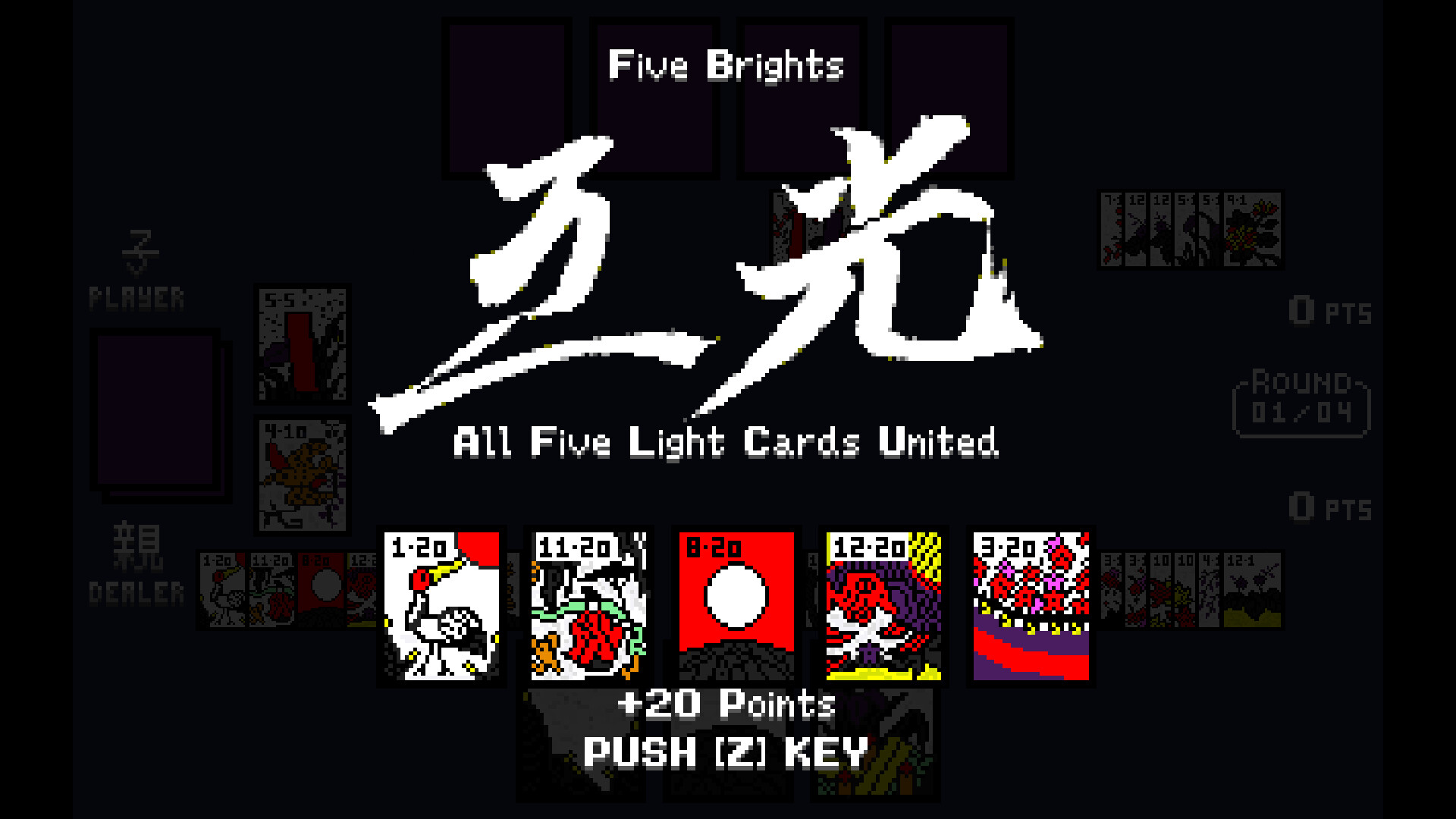
1. Gokō (Five Brights) — 10 pts
All five Bright cards.
Cancels Shikō and Sankō.
2. Shikō (Four Brights) — 7 or 8 pts
Four Brights.
7 pts if includes Willow (November), otherwise 8 pts.
Cancels Sankō.
3. Sankō (Three Brights) — 5 pts
- Three Brights excluding Willow (November).
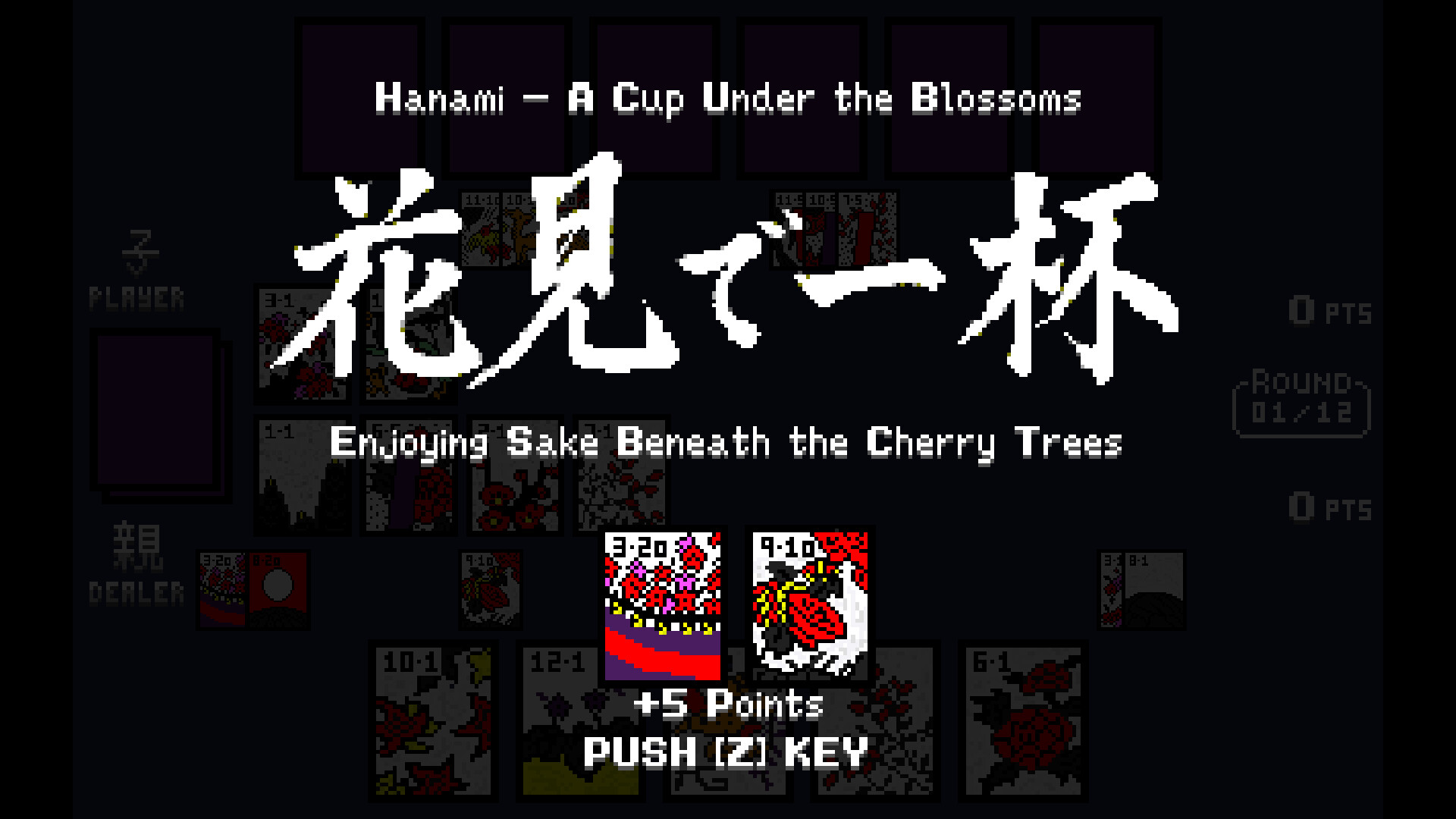
4. Hanami de Ippai (Cherry Blossom Viewing with Sake) — 5 pts
- March Bright (cherry blossom) + September Animal (sake cup).
5. Tsukimi de Ippai (Moon Viewing with Sake) — 5 pts
- August Bright (moon) + September Animal (sake cup).
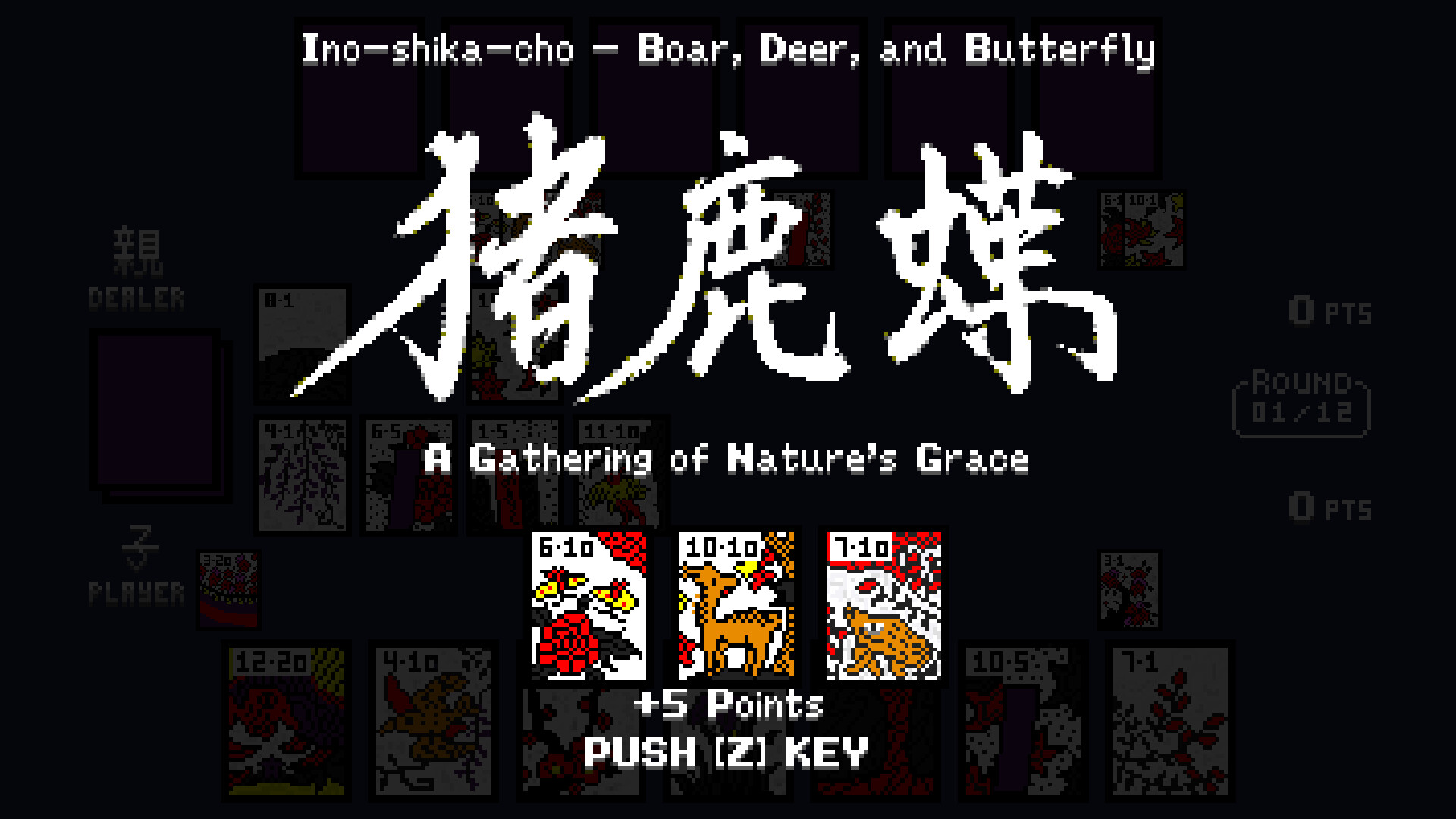
6. Inoshikachō (Boar-Deer-Butterfly) — 5 pts + bonus
June, July, and October Animals.
+1 pt for each extra Animal (max 12).
Cancels “Animal Set”.
7. Animal Set — 1 pt + bonus
5 or more Animal cards.
+1 pt for each additional. (e.g., 7 Animals = 3 pts)
8. Red & Blue Combo — 10 pts + bonus
All three Red Ribbons + all three Blue Ribbons.
+1 pt per extra Ribbon (max 13).
Cancels Red, Blue, and Ribbon Set hands.
9. Red Ribbons — 5 pts + bonus
All three Red Ribbons.
+1 pt per extra Ribbon.
Cancels “Ribbon Set”.
10. Blue Ribbons — 5 pts + bonus
All three Blue Ribbons.
+1 pt per extra Ribbon.
Cancels “Ribbon Set”.
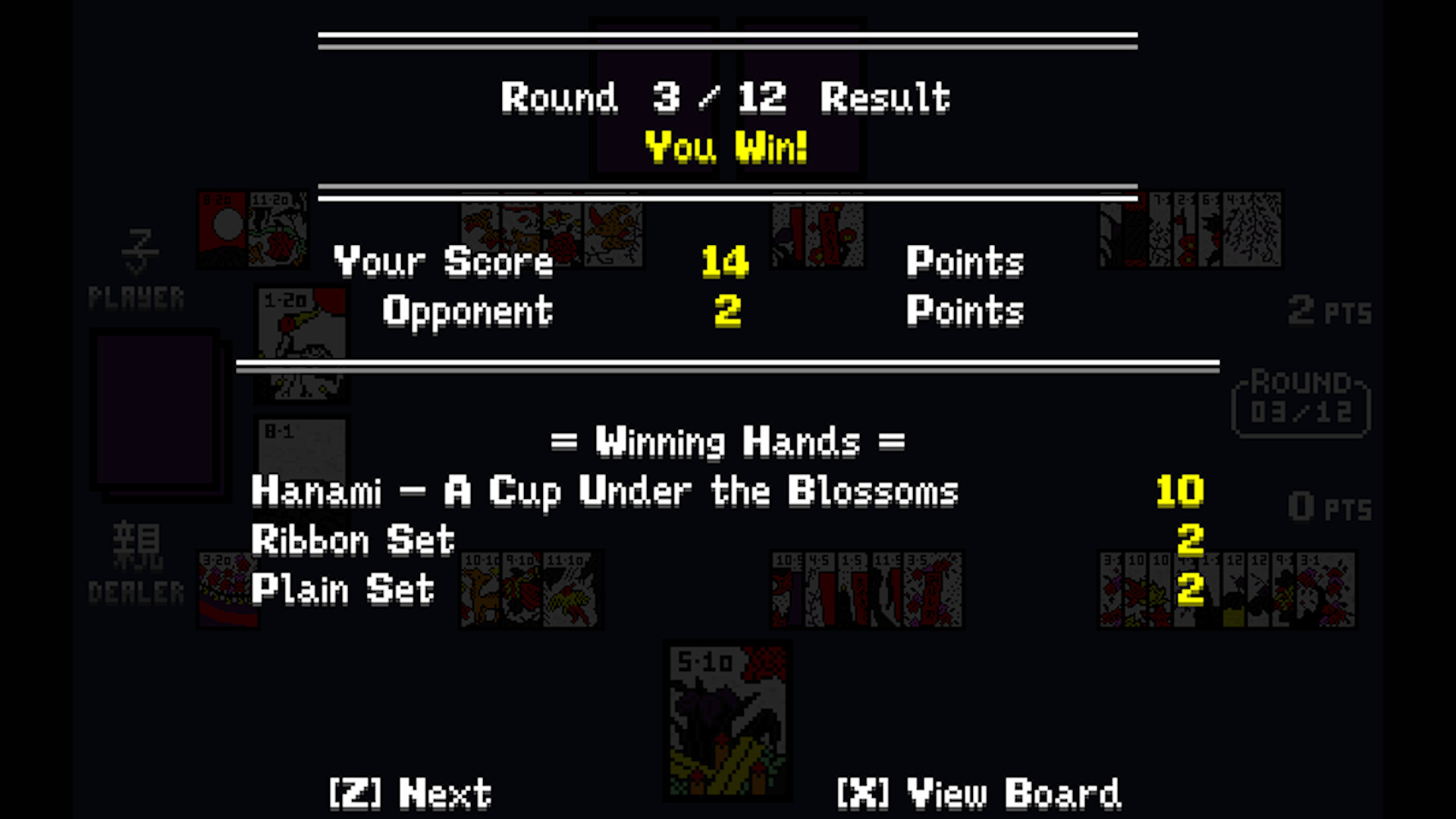
11. Ribbon Set — 1 pt + bonus
5 or more Ribbon cards.
+1 pt per additional.
12. Plain Set — 1 pt + bonus
10 or more Chaff cards.
+1 pt per additional.
Note: The Sake Cup (September Animal) also counts as Chaff.
🎮 Controls
A / × / Z key — Play a card / Confirm
B / ○ / X key — Cancel / Go back
X / □ / A key — Fast-forward animations
Y / △ / S key — Show hand list
Menu / Options / SPACE key — Pause the game
Ctrl + R key — Reset Program
Ctrl + Q key — Exit Program
✨ Recommended For
Beginners who’ve always wanted to try Hanafuda
Players looking for a quick, two-player battle game
Fans of Japanese-style, strategy, and mind-game experiences
People who enjoy tabletop games like poker or mahjong